

Tangram

How to play
The tangram is an ancient puzzle of Chinese origin, made by dividing a square into seven pieces called tans: a square, a rhomboid and five isosceles right-angled triangles – two large, one medium and two small.
By combining the Tangram pieces in the right way, you can make an almost infinite number of figures, some geometric, others resembling everyday objects, and so on. Every figure made with the Tangram must use all seven pieces.
How to play
Tangram is an ancient game of Chinese origin, obtained by breaking down a square into seven parts called tan: a square, a rhomboid, and five isosceles right-angled triangles, two of which are large, one medium and two small.
By appropriately combining the pieces of the Tangram, it is possible to obtain an almost infinite number of figures, some geometric, others reminiscent of everyday objects, etc. Any figure made with Tangram must be made up using all seven pieces.
Example
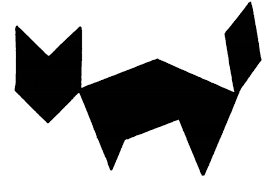
Here is a solved Tangram example. This is a cat made with all seven pieces. The white lines make it easy to see where each piece goes.

Example
This is a solved Tangram example. This is a cat figure made from all seven pieces. Through the white lines you will easily find the pieces’s positions.
The Tangram challenges
Now it’s your turn! Try to recreate these figures using all seven pieces of the TANGRAM.
The Tangram Challenge
Now it’s your turn! Try to recreate these figures by composing them with all seven pieces of the TANGRAM.

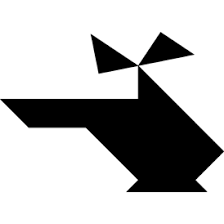
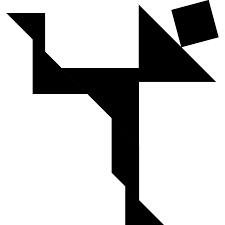






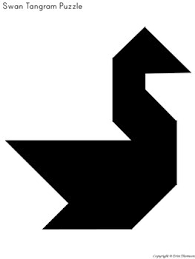
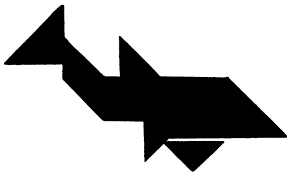



The maths of the Tangram
Some mathematical considerations and observations:
- There are only four different side lengths among the pieces, and two of them are double the other two.
- All the angles are multiples of 45˚.
- All the pieces except the parallelogram have at least one axis of symmetry.
What others can you spot?
The Tangram Maths
Some mathematical considerations and observations:
- The lengths of the sides of the tiles are only four, of which two are double the other two.
- All angles are multiples of 45˚.
- All tiles except the parallelogram have at least one axis of symmetry.
What others observations can you see?